The Scale of the Crash
The magnitude of today's oil price collapse has sent shockwaves through global energy markets. At the time of reporting, Brent crude had plunged by 7.62 percent, losing $7.54 to trade at $91.42 per barrel. Meanwhile, West Texas Intermediate (WTI) fell by 6.9 percent, shedding $6.54 to reach $88.23 per barrel.
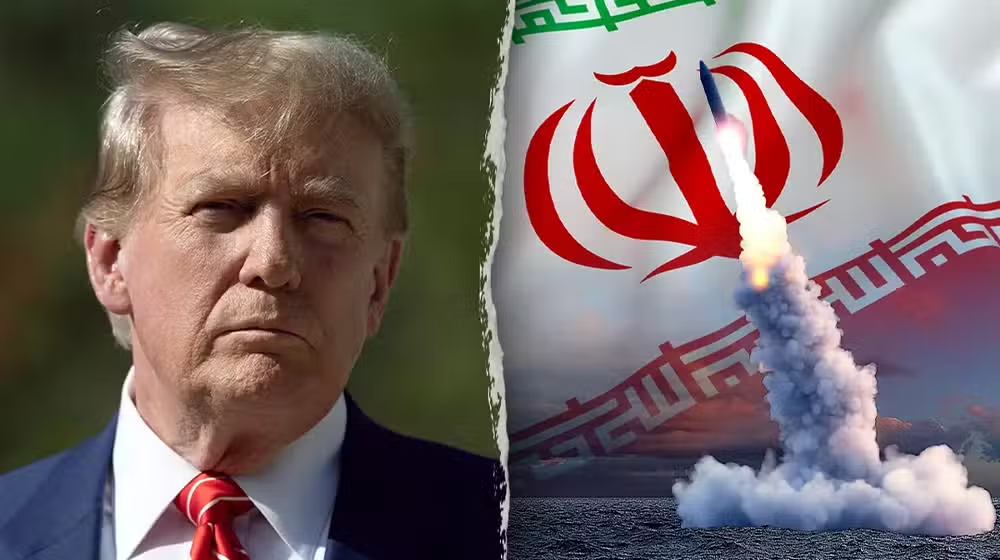
What makes this crash even more remarkable is that both contracts fell as much as nearly 12 percent during the earlier part of the trading session before recovering some losses. The initial panic selling was triggered by Trump's unexpected comments suggesting the United States may be preparing to scale back its military operations in the Middle East.
Oil Price Crash at a Glance
What Triggered the Sell-Off?
The crash was primarily driven by President Trump's surprise indication of a potential withdrawal or de-escalation from the US-led military campaign against Iran. The phrase "conditional de-escalation" used by the President sent a clear signal to energy markets that the geopolitical risk premium built into oil prices over recent weeks could evaporate rapidly.
Just a day earlier on Monday, oil prices had climbed above $110 per barrel — reaching their highest levels since mid-2022. That surge was fueled by a combination of supply disruptions from Saudi Arabia and other producers amid the escalating US-Israeli military campaign against Iran.
Timeline of Events
The Russia-Trump Diplomatic Connection
A critical behind-the-scenes development preceded the crash. Reports emerged on Monday evening that Russian President Vladimir Putin had directly spoken with Donald Trump, putting forward proposals for a rapid and peaceful resolution to the Iran conflict. This diplomatic engagement appears to have planted the seeds for Trump's subsequent de-escalation rhetoric.
The Putin-Trump conversation is significant for several reasons. Russia, as one of the world's largest oil producers, has complex interests in the Middle East conflict. While higher oil prices benefit Russian revenues, prolonged instability in the region also poses risks to Moscow's geopolitical calculations. A brokered peace deal would allow Russia to position itself as a diplomatic mediator while managing global oil supply dynamics to its advantage.
Expert Analysis: Overreaction in Both Directions
Energy sector experts have weighed in with a balanced but cautious assessment of the situation. One prominent analyst noted that Monday's spike above $110 represented a clear overreaction to geopolitical tensions — markets had priced in a worst-case scenario of prolonged supply disruptions that may never materialize.
— Energy Sector Expert
However, the same analyst cautioned that Tuesday's dramatic decline may also be undershooting the true risk profile for oil. The "conditional" nature of any US withdrawal leaves significant uncertainty. If conditions for de-escalation are not met — or if Iran perceives the shift as a sign of American weakness and escalates further — prices could rapidly rebound to even higher levels than Monday's peak.
Why This Crash Matters
The implications of this oil price crash extend far beyond trading floors and energy company balance sheets. For oil-importing nations like Pakistan, every dollar change in crude oil prices has a direct and material impact on the national economy.
Lower Import Bill
Pakistan imports a significant portion of its petroleum needs. A sustained drop in oil prices could reduce the oil import bill by billions of rupees annually, easing pressure on foreign exchange reserves and the current account deficit.
Fuel Price Relief
If international oil prices remain at lower levels, Pakistani consumers could see relief at the pump. Lower petrol and diesel prices would reduce transportation costs and ease inflationary pressures across the economy.
Energy Cost Reduction
Lower crude oil prices typically translate to reduced costs for furnace oil and other petroleum-based fuels used in power generation. This could provide relief from the high electricity tariffs that burden both industries and households.
Volatility Risk
The extreme swings — from $110+ to below $90 in two days — highlight dangerous market volatility. Pakistan's energy planning and budgetary forecasts become extremely challenging when prices can swing 20% within 48 hours.
The Broader Geopolitical Picture
This oil price crash is fundamentally a story about the intersection of US foreign policy, Middle Eastern geopolitics, and global energy markets. The US-led military campaign against Iran had progressively pushed oil prices higher over recent weeks as markets priced in the risk of sustained supply disruptions in one of the world's most critical oil-producing regions.
Trump's hint at withdrawal underscores a growing reality: the US military campaign in the Middle East has not proceeded as planned. The phrase used by the analyst — "the US is in trouble" — reflects a broader assessment that American military objectives in the region have become increasingly difficult to achieve, creating political pressure domestically for an exit strategy.
Uncertainty Remains High
Despite the dramatic price drop, market participants should exercise caution. The word "conditional" in Trump's de-escalation hint is crucial — it means no concrete withdrawal plan has been established. Several scenarios could quickly reverse today's losses:
- Iran could escalate military operations, perceiving US hesitation as weakness
- De-escalation conditions may not be met, prolonging the conflict
- Saudi Arabia and OPEC+ may maintain supply cuts regardless of peace talks
- Other geopolitical flashpoints could re-ignite supply concerns
Impact on Pakistan's Economy
For Pakistan, the oil price crash — if sustained — could provide a much-needed economic lifeline. The country has been grappling with high energy costs, inflationary pressures, and a strained current account. Here's how the crash could affect the Pakistani economy:
Positive Implications
- Current Account Relief: A sustained $15-20 drop in oil prices could save Pakistan approximately $3-4 billion annually on its petroleum import bill
- Inflation Control: Lower fuel prices feed through the entire supply chain, reducing transport and production costs for goods and services
- Rupee Stability: Reduced dollar demand for oil imports could ease pressure on the Pakistani rupee exchange rate
- Fiscal Space: Lower oil prices give the government more room for subsidies or public spending without expanding the fiscal deficit
- Industrial Competitiveness: Cheaper energy inputs would help Pakistani industries compete more effectively in export markets
Cautionary Notes
- Volatility Makes Planning Difficult: Wild price swings make it impossible for policymakers to lock in favorable rates or make long-term energy budget commitments
- Government Revenue Impact: Lower oil prices also mean reduced petroleum levy collections, which form a significant portion of government revenue
- Geopolitical Instability: Pakistan's proximity to the conflict zone means any escalation could have direct security and economic consequences beyond oil prices
Pakistan Oil Import Dependency
Pakistan imports approximately 85% of its crude oil needs, making it highly sensitive to international price movements. The country's petroleum import bill in recent months had been climbing steadily as war-driven prices pushed Brent above $100. Today's crash — if it holds — could provide significant balance of payments relief.
Key Fact: For every $1 decrease in the price of Brent crude, Pakistan saves approximately $200-250 million annually on its oil import bill. Today's $7.54 drop, if sustained, could translate to savings of $1.5-1.8 billion per year.
What Happens Next?
The coming days and weeks will be critical in determining whether today's crash represents a genuine turning point or merely a temporary correction in an otherwise upward trend. Several factors will be closely watched by market participants:
- Trump's Follow-Through: Will the de-escalation rhetoric translate into concrete military drawdown plans, or was it merely a trial balloon?
- Iran's Response: How Tehran reacts to the possibility of US withdrawal will significantly influence oil market sentiment
- OPEC+ Decision: Whether Saudi Arabia and other producers adjust output levels in response to the price crash
- Russian Diplomacy: Putin's continued mediation efforts could either accelerate peace or complicate an already tangled situation
- Market Positioning: Traders who had built large long positions on war premiums may face forced liquidation, adding further downward pressure
Conclusion: A Defining Moment for Global Energy Markets
Today's oil price crash represents one of the most dramatic single-day moves in crude oil markets in recent memory. The nearly 12 percent intraday plunge, followed by a partial recovery to settle around 7 percent lower, reflects the extreme sensitivity of energy markets to geopolitical developments.
For Pakistan and other oil-importing nations, the crash offers a glimmer of hope for economic relief — but the "conditional" nature of Trump's de-escalation hint means that uncertainty remains the dominant force in energy markets. A prudent approach would be to welcome the price relief while preparing contingency plans for a rapid reversal if geopolitical conditions deteriorate.
The one certainty in today's oil market is uncertainty itself. Traders, policymakers, and consumers alike should prepare for continued volatility as the complex interplay between US foreign policy, Middle Eastern conflict dynamics, and global energy supply chains continues to unfold in the weeks ahead.