Why the Strait of Hormuz Matters
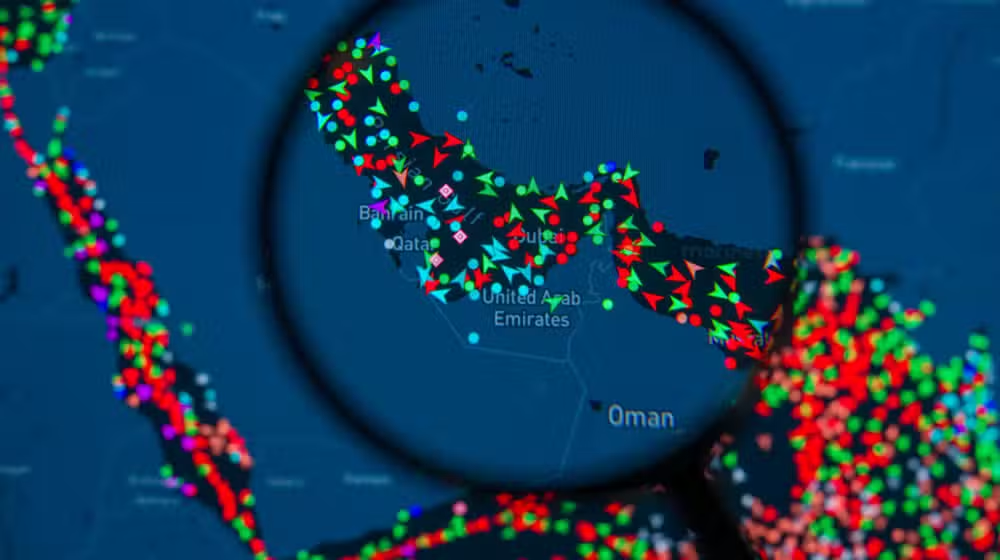
The Strait of Hormuz is a narrow channel between Iran and Oman that connects the Persian Gulf to the Gulf of Oman and, from there, the open ocean. It is arguably the most important oil chokepoint on Earth. Roughly one-fifth of the world's total petroleum consumption passes through its waters on a daily basis, along with a significant share of global liquefied natural gas (LNG) exports.
Any disruption — even a temporary slowdown — in this corridor sends immediate shockwaves through global energy markets. Tanker insurance premiums spike, crude futures jump, and importing nations scramble for alternative supply routes that are often slower and more expensive.
What Sparked This Announcement?
The statement from Tehran follows an escalation in rhetoric from Washington. US President Donald Trump reportedly warned that strikes would target Iranian power infrastructure if the Strait of Hormuz were not kept fully accessible within a 48-hour window. That ultimatum heightened fears of a direct military confrontation that could choke off energy supplies for much of Asia and Europe.
Meanwhile, the ongoing US-Israeli military campaign against Iran has already reduced the volume of commercial traffic through the strait. Shipping companies and insurers have been increasingly cautious, with some re-routing tankers around the longer Cape of Good Hope route to avoid the risk zone entirely.
Iran's Position in Brief
Iran's representative to the International Maritime Organization stated that Tehran is prepared to work with global maritime authorities to guarantee safety in the Gulf. Ships that are not associated with hostile nations can continue to transit the strait by coordinating with the Iranian government. He stressed that Iran still favours diplomacy, but noted that ending hostilities and restoring trust are necessary conditions.
Who Counts as an 'Enemy'?
Iran's statement deliberately left the definition of "enemy ships" vague, which in itself is a strategic move. The ambiguity gives Tehran maximum flexibility — it can selectively enforce the restriction based on evolving diplomatic conditions without committing to a rigid list of banned nations.
In practice, the primary targets of this policy are almost certainly vessels flagged to or chartered by the United States and Israel, along with any coalition partners actively involved in military operations against Iran. However, the lack of a published exclusion list means that neutral shipping companies may also face uncertainty about whether they will be cleared for passage.
The Blame Game
Tehran has placed responsibility for the current tensions squarely on Washington and Tel Aviv. Iranian officials argue that recent US and Israeli military operations in the region are the direct cause of disrupted shipping lanes and rising insurance costs. From Iran's perspective, the country is exercising its sovereign right to control waters adjacent to its coastline while keeping commercial traffic flowing for the global economy.
The United States, on the other hand, frames any restriction on Hormuz traffic as an act of economic warfare against the international community. Washington's position is that the strait must remain unconditionally open under international maritime law, regardless of the broader military conflict.
Escalation Risk Remains High
Military analysts warn that a single incident — an accidental collision, a misidentified vessel, or an overzealous naval patrol — could rapidly turn a controlled standoff into a full maritime crisis. With warships from multiple nations operating in close proximity within a narrow waterway, the margin for error is extremely thin.
Impact on Pakistan and South Asia
Pakistan is particularly vulnerable to disruptions in the Strait of Hormuz. The country imports a large majority of its crude oil and a significant portion of its LNG through Gulf supply routes that depend on unimpeded passage through the strait.
Energy Supply Risk
Pakistan receives LNG shipments from Qatar and other Gulf producers that transit through Hormuz. Any sustained blockage or slowdown could trigger gas shortages, power outages, and industrial disruptions.
Rising Import Costs
Higher tanker insurance premiums and longer alternative shipping routes translate directly into increased energy import costs, worsening the trade deficit and putting upward pressure on inflation.
Port & Trade Disruption
Pakistan's key ports at Karachi and Gwadar sit close to the strait. Heightened military activity in the area could discourage commercial vessels from calling at Pakistani ports entirely.
Diplomatic Opportunity
As a neighbour that maintains diplomatic relations with both Tehran and Washington, Pakistan could play a mediating role — reinforcing its strategic relevance in the region.
Global Energy Markets on Edge
Even before Iran's latest declaration, energy markets had been pricing in a significant geopolitical risk premium. Crude oil prices have been volatile for weeks, swinging between war-driven spikes and correction dips triggered by diplomatic signals. The Hormuz factor adds another layer of uncertainty that makes it nearly impossible for traders, governments, or consumers to plan ahead with confidence.
European nations that have been diversifying away from Russian gas toward Gulf LNG are especially exposed. A meaningful reduction in Hormuz throughput would force them back toward spot markets at premium prices — or, in extreme scenarios, toward energy rationing.
— Energy Market Analysis
What to Watch Next
The coming days will be critical. Several developments could either calm or escalate the situation:
- US Response to Iran's Conditions: Whether Washington accepts the partial-access arrangement or insists on unconditional passage will set the tone for what comes next.
- Insurance Market Reaction: If maritime insurers raise war-risk premiums further, shipping companies may voluntarily avoid the strait regardless of Iran's policy.
- Naval Movements: Any repositioning of US, Iranian, or allied naval assets near the strait will be closely watched for signals of intent.
- Diplomatic Back-Channels: Quiet negotiations — possibly involving Oman, Qatar, or other Gulf intermediaries — may be the best hope for de-escalation.
- OPEC+ Communication: Whether major producers reassure markets about alternative supply routes or production adjustments.
Bottom Line
Iran's announcement is a calculated blend of reassurance and deterrence. By keeping the strait nominally open while reserving the right to block certain vessels, Tehran signals that it does not want a full economic confrontation with the global community — but will not yield its strategic leverage under military pressure. For energy-importing nations like Pakistan, the situation demands close monitoring, contingency planning, and active diplomatic engagement to prevent a localised standoff from becoming a global energy crisis.